Undergraduate Thesis · Practice-Based Game Design Research
Naibu: Visual Metaphor, Animation and Interaction for Representing Social Anxiety in a 2D Videogame
How can a two-dimensional puzzle-platformer communicate an experience related to social anxiety — not by describing it, but by making it playable?
Abstract
Naibu is a practice-based game design project that investigates how a two-dimensional puzzle-platform videogame can communicate an experience related to social anxiety through visual metaphor, interactive narrative, world design, character design, animation and game mechanics. The project was developed as an undergraduate thesis at Universidad de La Sabana and completed as a playable vertical slice supported by a full design and pre-production corpus: concept research, narrative structure, character and enemy design, level and palette systems, animation cycles and mechanical prototypes.
The enquiry proceeds through design rather than through evaluation. Rather than measuring an effect on players, the project asks what a designer must decide in order to represent a subjective emotional experience in an interactive form, and traces those decisions across the whole game system. The emotional concept is deliberately distributed: it is carried by the relationship between environment, antagonists, colour, movement, animation timing, narrative structure and the moment-to-moment demands of the mechanics, rather than stated through dialogue or exposition.
The project is explicitly not offered as a clinical intervention, a diagnostic instrument or a therapeutic tool, and it makes no claim to reproduce a universal experience of social anxiety. Its contribution is a documented account of one designerly interpretation and the practice-derived considerations that emerged from producing it — most centrally, that metaphor can communicate subjective experience where simulation would over-claim, that simple mechanics acquire emotional meaning contextually, and that conceptual interpretation of a sensitive experience must precede aesthetic refinement.
This updated edition preserves the structure, creative decisions and outcomes of the original 2019 project. Retrospective academic commentary and updated references are clearly identified as such and are not presented as findings of the original work.
Research at a Glance
Question → contribution → evidence, in brief
Research question
How can visual metaphor, animation, environment and game mechanics be combined so that a 2D videogame communicates an experience related to social anxiety, without stating it explicitly and without claiming to simulate it?
Problem
Games that address mental-health experiences frequently fall into two modes: exposition, where a character or text explains the condition, or simulation, where the game claims to reproduce what the condition is like. Both flatten a subjective experience into a single account, and simulation in particular risks presenting one interpretation as universal. There was little practice-facing guidance on the intermediate path — representing an emotional experience through the design of the system itself.
Approach
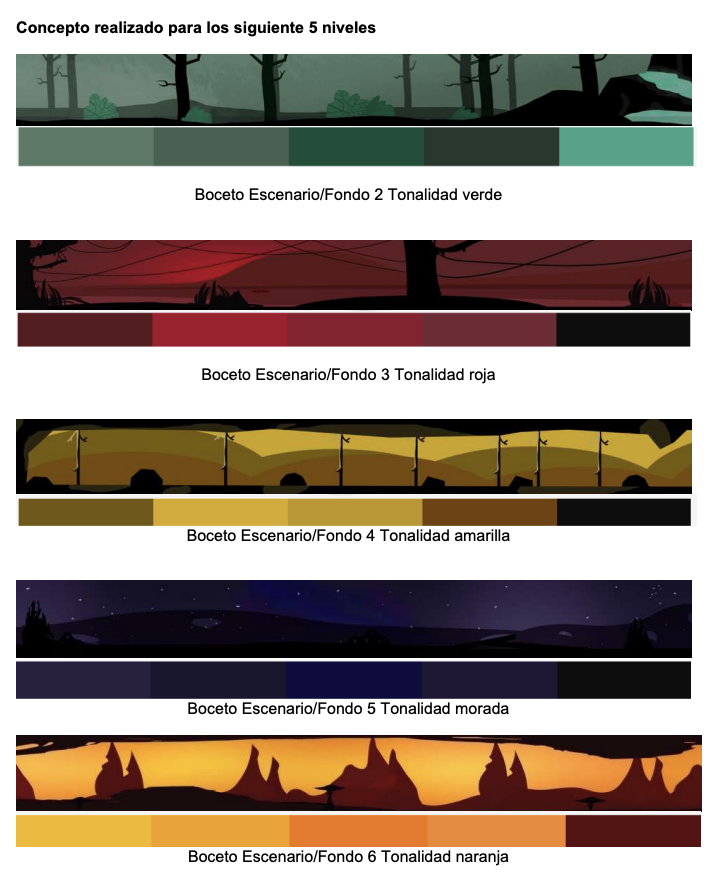
Practice-based research through design across a six-month structured production: concept and folklore research; narrative construction; character, enemy and world design; a constrained six-colour palette per emotional stage; hand-animated cycles; paper prototyping of roughly twenty mechanics narrowed to six mapped onto emotional beats; Unity/C# implementation; and iterative playtesting. Design decisions and their rationale were documented throughout, and the reasoning was reconstructed retrospectively into the mapping presented below.
Contribution
A documented case of translating an emotional concept into an interactive system, together with a Concept-to-Interaction mapping that makes the translation steps inspectable, and a set of seven practice-derived design considerations for representing sensitive emotional experiences in games. The contribution is designerly knowledge — an artefact plus an account of the reasoning that produced it — not an empirical result.
Findings / Outcomes
A playable vertical slice covering three emotional stages (denial → anger → acceptance), with a complete art, animation and level corpus. The thesis was awarded a Meritorious distinction (4.8 / 5.0). The work was subsequently selected for MAGI Expo (2024), the Future Forte inaugural showcase (2025) and a month-long exhibition at Bunjil Place (2025). Across exhibition contexts, viewer response concentrated on how mechanical and palette changes carried emotional state without dialogue.
Limitations
The project was a design and pre-production project, not an evaluation. It demonstrates no change in symptoms, empathy, knowledge, stigma or behaviour, and it was not developed with clinical consultation. Its representation is one designer’s interpretation, and should be read as a case of emotional representation through game design rather than as evidence about social anxiety.
Questions this research can help answer
- How can videogames represent social anxiety through visual metaphor?
- How can emotional experiences be translated into game design?
- How can environmental storytelling communicate mental-health experiences?
- How can animation contribute to emotional communication in videogames?
- How can game mechanics and narrative work together to represent emotional states?
- What are the challenges of representing mental-health experiences in entertainment games?
- How can a game address mental-health themes without becoming a clinical intervention?
These are the questions the project is positioned to inform. It answers them as a documented design case, not as empirical evidence.
Key Contributions
Emotional concepts distributed across the game system
The emotional concept is communicated through relationships between environment, enemies, colour, animation, narrative and interaction rather than through exposition alone. No single element carries the meaning; it emerges from how they hold together.
Metaphor rather than simulation
Naibu uses visual and interactive metaphor to communicate an interpretation of an emotional experience without claiming to reproduce a universal experience of social anxiety. Metaphor leaves the interpretation legible as an interpretation.
Simple mechanics, contextual meaning
The project explores how relatively simple mechanics can acquire emotional meaning through their relationship with narrative, audiovisual design and environmental context — the same verb reads differently depending on the world it is performed in.
Responsible representation
The project highlights the need to distinguish representations of situational emotional experiences from stereotypes about people experiencing mental-health conditions, and treats that distinction as a design constraint rather than a disclaimer.
Concept before visual polish
The development process demonstrates the importance of conceptualising the emotional experience and its design implications before finalising visual representation — aesthetic decisions made early tend to fix the interpretation before it has been examined.
These are practice-derived design considerations drawn from the making of one project. They are not scientifically validated principles and should not be cited as such.
Concept-to-Interaction Mapping
- Emotional Experiencethe subjective experience being addressed
- Conceptual Attributeswhat characterises it — exposure, avoidance, scale, watchfulness
- Design Intentionwhat the game should make the player notice
- Visual Metaphorthe image system that carries the concept
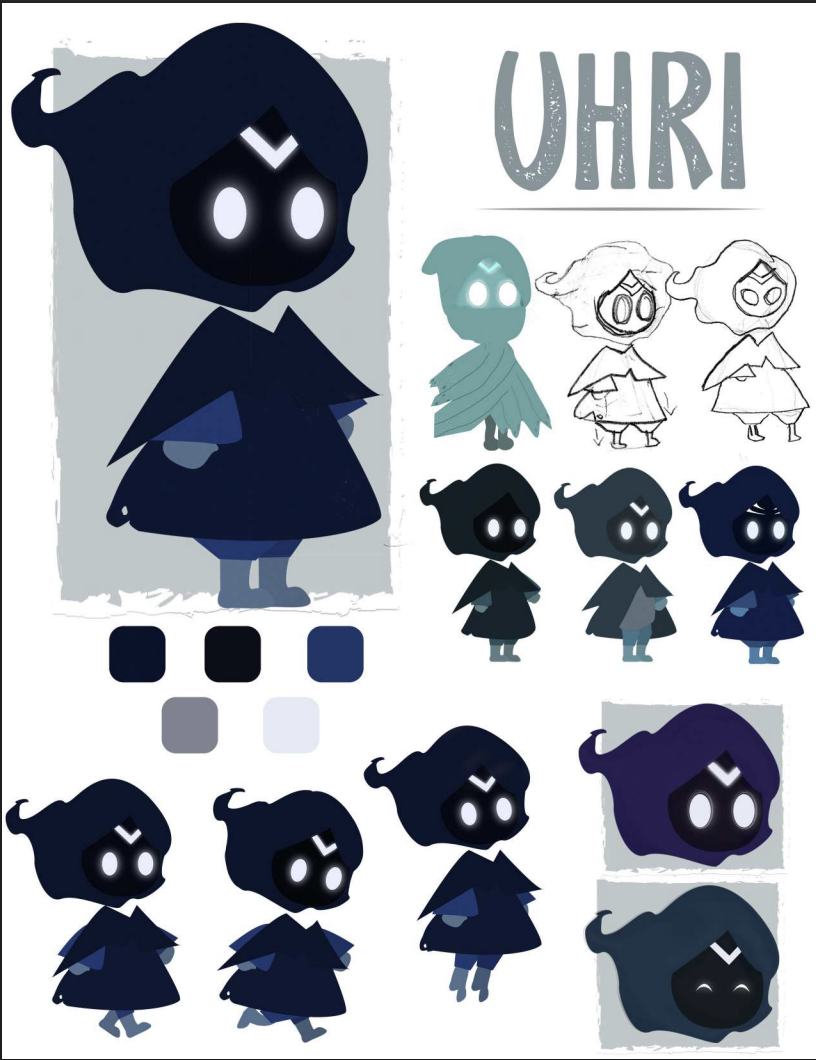
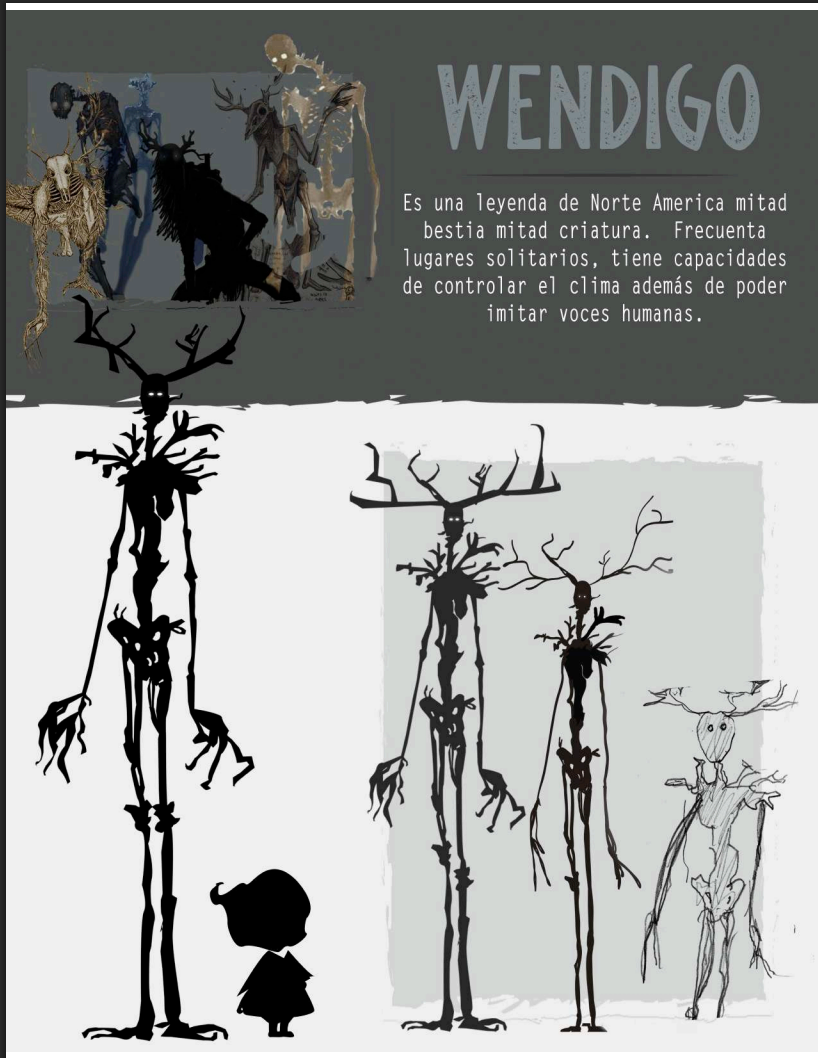
- World + Characters + Animationpalette, silhouette, antagonists, movement timing
- Narrative + Mechanicsstructure and verbs that enact the metaphor
- Interactionwhat the player actually does, moment to moment
- Intended Player Interpretationthe reading the system invites — not guarantees
Practice-Derived Design Considerations
Distribute emotional representation across the system
Spread the emotional argument across multiple elements of the game — environment, palette, movement, sound, structure — rather than concentrating it in one explanatory moment.
Let simple mechanics gain meaning contextually
Allow simple mechanics to acquire meaning through narrative and contextual relationships instead of adding mechanical complexity to signal emotional complexity.
Use metaphor to communicate subjective experience
Metaphor can communicate a subjective experience without claiming universal simulation. It positions the work as one interpretation, which is both more honest and more designable.
Avoid reducing mental-health experiences to personality stereotypes
Represent situations, responses and relationships rather than character types. A stereotype is a shortcut that trades accuracy for legibility.
Develop the conceptual interpretation before aesthetic refinement
Establish what the work is claiming about the experience — and what it is not — before committing to a visual language that will quietly settle the question.
Treat environments as part of the emotional argument
Game worlds are not backgrounds. Scale, density, light and navigability are among the strongest available carriers of emotional meaning.
Declare the register of the work
Clearly distinguish whether a game aims to support representation, reflection, literacy, behaviour change or therapeutic intervention. These are different projects with different obligations, and conflating them misleads players and reviewers alike.
These considerations were derived retrospectively from the design process. They were not empirically validated by the original project, and are offered as design guidance rather than as findings.
Selected design material

Limitations
What this research does not establish:
- The project was primarily a design and pre-production project, delivered as a vertical slice rather than a complete released game.
- It was not evaluated as a mental-health intervention, and no player study was conducted.
- The project does not demonstrate changes in symptoms, empathy, knowledge, stigma or behaviour.
- The representation reflects a particular designerly interpretation of social anxiety rather than a universal experience of it.
- Future work would benefit from consultation with mental-health specialists and from co-design with people with relevant lived experience.
- The work should be interpreted as a practice-based case of emotional representation through game design, and cited on those terms.
How to Cite
APA
Olarte Ávila, T. C. (2019). Naibu: Visual metaphor, animation and interaction for representing social anxiety in a 2D videogame [Undergraduate thesis, Universidad de La Sabana]. (Updated edition, 2026).
BibTeX
@mastersthesis{olarteavila2019naibu,
  author      = {Olarte {\'A}vila, Tania Catherine},
  title       = {Naibu: Visual Metaphor, Animation and Interaction for Representing Social Anxiety in a 2D Videogame},
  school      = {Universidad de La Sabana},
  type        = {Undergraduate thesis},
  year        = {2019},
  note        = {Updated edition, 2026},
  url         = {https://taniaolarte.com/research/naibu-social-anxiety-game-design}
}A DOI will be added here once the repository record for the updated edition is confirmed. Until then, please cite the permanent URL above.
← All researchUpdated Edition · last updated 2026